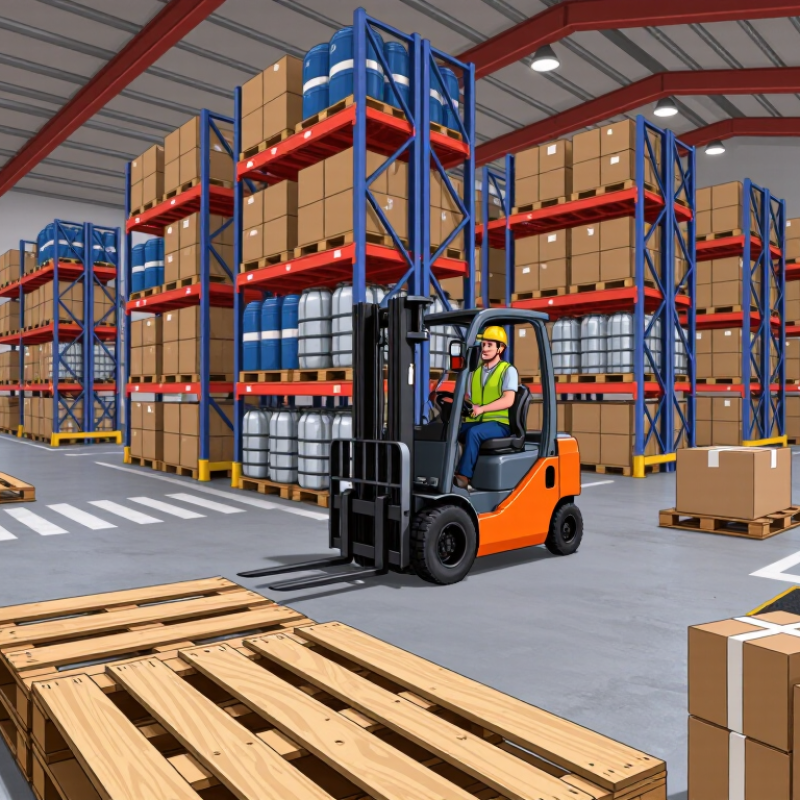
How to Choose Material Handling Equipment for Your Business?
Choosing Material Handling Equipment is not simply a matter of buying the strongest machine available. It requires a clear understanding of your products, workspace, people, and daily movement patterns. A warehouse handling wooden pallets needs different solutions from a facility moving fragile cartons or liquid containers. Measure aisle widths, ceiling heights, floor conditions, and loading points before comparing equipment. Small details matter. A turning forklift may fit on paper but fail beside a crowded storage rack.
Practical experience should guide technical decisions. Review load weights, lifting heights, travel distances, operating frequency, and environmental conditions. Cold rooms, dusty floors, and outdoor yards can quickly expose weak equipment choices. Check manufacturer specifications, safety features, service availability, energy use, and operator training requirements. Reliable suppliers should explain limitations, not only advertise capacity. A risk assessment and maintenance plan also protect productivity over time. The cheapest option may create expensive downtime. That lesson is easy to overlook.
No selection method is perfect. A spreadsheet can miss human behavior, seasonal demand, or an awkward doorway. Test equipment in realistic conditions whenever possible. Ask operators what slows them down. Their practical knowledge is often more useful than assumptions made in an office. This guide explores how to compare equipment types, calculate long-term value, and build a safer, more efficient handling system for your business. The right choice should support today’s workflow without blocking tomorrow’s growth.
Define Your Material Handling Needs and Operational Goals
Before choosing material handling equipment, define what your operation must achieve. Walk through each workflow, from receiving pallets to storing cartons and loading orders. Record product weight, dimensions, travel distances, aisle widths, and daily handling volume. These details reveal whether you need lifting, transporting, stacking, or positioning support.
Talk with operators who use the equipment every shift. Their experience often exposes problems that production reports miss, such as awkward controls, poor visibility, or repeated turning. Set measurable goals, including faster order movement, fewer damaged goods, reduced manual lifting, and safer traffic flow. Equipment should fit the task, not force workers to change efficient habits. I have seen teams focus on capacity alone and overlook charging access, floor conditions, and maintenance time. That mistake can become expensive.
Tips:
Test equipment in the actual work area before making a purchase. Place a sample load on the floor and measure turning space with a tape measure. Check noise, control comfort, visibility, and stopping distance. Ask operators to repeat common tasks, including narrow-aisle turns and uneven-floor travel. Compare expected performance with real observations. Small differences matter. Review your goals every few months, because product sizes, order patterns, and staffing levels may change. A perfect choice today may need adjustment later.
Assess Equipment Types for Loads, Workflows, and Facility Conditions
Choosing material handling equipment starts with the load, not the catalogue. Record weight, dimensions, fragility, center of gravity, and daily movement frequency. A narrow-aisle warehouse may need compact equipment, while outdoor yards require weather-resistant designs and stable tires. Measure door heights, floor strength, turning radii, ramps, and charging areas before comparing models.
Workflow matters just as much. Map each movement from receiving to storage, picking, staging, and dispatch. Frequent short trips may favor powered transport equipment. High-volume, repetitive routes may justify conveyors or automated systems. MHI’s 2024 Industry Report found that 55% of supply chain professionals planned to increase investment in automation and technology. That figure supports careful evaluation, not automatic automation.
Safety must shape the decision. OSHA reports that powered industrial trucks cause about 85 fatalities and 34,900 serious injuries annually in the United States. Select equipment with suitable visibility, controls, load capacity, and operator protection. Training and traffic separation remain essential. A perfect spreadsheet can still miss wet floors or blind corners. Walk the facility during peak activity. Ask operators what slows them down. Their answers may challenge the original specification. A smaller machine could improve access, yet reduce battery endurance. A cheaper option may create higher maintenance costs. Test the complete workflow before purchasing.
| Equipment Type | Typical Rated Capacity | Best-Suited Loads | Workflow Fit | Facility Conditions | Key Advantages | Important Limitations | Selection Considerations |
|---|---|---|---|---|---|---|---|
| Manual Pallet Truck | 2,000–2,500 kg | Standard pallets, cartons, drums, and short-distance unit loads | Low-volume movement Loading docks Receiving | Flat, smooth floors; narrow operating areas; no charging infrastructure required | Low purchase cost, simple operation, minimal maintenance, and no battery charging | Requires operator pushing or pulling; unsuitable for long travel distances, ramps, or frequent high-volume movement | Check pallet entry dimensions, floor condition, wheel material, handle height, and actual load center |
| Electric Pallet Truck | 1,500–2,500 kg | Palletized goods, packaged food, cases, and repetitive horizontal loads | Medium-volume movement Order staging Dock transfer | Indoor facilities with suitable charging areas and generally level floors | Reduces physical effort and supports longer travel distances than manual trucks | Higher cost than manual models; battery charging, maintenance, and pedestrian-control procedures are required | Compare battery type, shift duration, turning radius, tiller design, ramp capability, and travel speed |
| Counterbalance Forklift | 1,500–5,000 kg | Pallets, machinery, building materials, bulk containers, and irregular loads | General handling Loading and unloading Outdoor work | Requires adequate aisle width, load-bearing floors, marked travel routes, and ventilation for internal-combustion models | Versatile lifting and transport; suitable for docks, yards, and mixed load profiles | Needs trained operators; counterweight increases turning space; combustion models produce emissions and noise | Select electric, LPG, diesel, or other power options according to indoor-air, noise, duty-cycle, and outdoor-use requirements |
| Reach Truck | 1,000–2,500 kg | Pallets stored in selective racking at medium and high elevations | High-density storage Put-away Pallet retrieval | Indoor warehouses with smooth, level floors, stable rack systems, and narrow aisles commonly around 2.5–3.0 m | Uses vertical space efficiently and offers better maneuverability than many counterbalance forklifts | Less suitable for rough outdoor surfaces, ramps, and very irregular loads; residual capacity decreases at greater lift heights | Verify lift height, aisle width, rack beam height, mast configuration, visibility, and floor flatness |
| Very Narrow Aisle Truck | 1,000–1,500 kg | Pallets in high-density storage systems with standardized rack positions | High-throughput storage High-bay picking Pallet handling | Precisely installed racks, smooth floors, guidance systems, and aisles often below 2.0 m depending on configuration | Maximizes storage density and vertical utilization | Usually restricted to dedicated aisles; less flexible for loading docks, open yards, or mixed traffic | Assess rack geometry, guidance method, lift height, floor tolerances, emergency access, and operator protection |
| Order Picker | E-commerce Case picking Store replenishment | Indoor aisles with stable shelving, pedestrian controls, and safety systems for elevated work | Improves access to individual items and supports multi-line order fulfillment | Not intended for heavy pallet transport; elevated platforms require fall protection and operator training | Match platform height, picking frequency, aisle dimensions, load distribution, and access-control requirements | ||
| Stacker | 600–1,500 kg | Light-to-medium pallets, small loads, and storage in low- to medium-height racks | Small warehouses Back-room storage Occasional stacking | Indoor, level floors; compact aisles; generally shorter travel distances | More economical and compact than many rider forklifts; electric versions produce no local exhaust emissions | Lower travel speed and capacity than counterbalance forklifts; performance can be affected by uneven floors and ramps | Check mast height, stabilizer-leg clearance, pallet type, turning radius, and duty cycle |
| Conveyor System | Application-dependent | Cartons, totes, parcels, trays, and consistently sized unit loads | Continuous flow Sortation Packing lines | Requires a defined layout, suitable power supply, structural support, guarding, and controlled transfer points | Provides predictable, repeatable movement and can reduce manual travel between fixed workstations | Less flexible after installation; unsuitable for highly variable routes or frequently changing product dimensions without adaptable design | Define throughput, product dimensions, accumulation needs, elevation changes, noise limits, guarding, and emergency-stop locations |
| Automated Guided Vehicle (AGV) | Commonly 500–2,000 kg | Standardized pallets, carts, bins, and repeatable production or warehouse loads | Repetitive routes Scheduled replenishment 24/7 operations | Requires defined routes, reliable navigation references, controlled pedestrian interaction, and suitable floor conditions | Automates repetitive transport and can provide consistent movement records and scheduling | Higher implementation complexity; traffic changes, obstructions, and inconsistent load presentation can reduce performance | Evaluate route stability, traffic density, charging strategy, interface points, safety validation, and expected utilization |
| Autonomous Mobile Robot (AMR) | Commonly 300–1,500 kg | Totes, carts, shelves, and pallet loads depending on the platform design | Flexible routing Goods-to-person Variable workflows | Requires mapped operating zones, reliable floor surfaces, safety-rated sensors, and integration with warehouse systems | Can adapt routes around obstacles and support changing warehouse layouts more easily than fixed conveyors | Performance depends on software integration, traffic management, load presentation, and charging availability | Assess payload stability, navigation accuracy, fleet controls, system integration, pedestrian safety, and peak-demand capacity |
| Mobile Scissor Lift Table | Typically 150–1,000 kg | Parts, tooling, cartons, work-in-process materials, and ergonomic workstations | Workstation support Assembly Maintenance | Stable floors with sufficient clearance; lifting height and wheel arrangement must suit the work area | Improves ergonomic positioning and reduces repeated bending or manual lifting | Not designed for long-distance transport or high-throughput pallet movement; requires stability controls | Check platform size, lowered and raised height, load distribution, wheel locks, safety guards, and operating frequency |
| Dock Leveler | Commonly 9,000–30,000 kg distributed load | Forklifts, pallet trucks, and wheeled loads crossing between a dock and vehicle floor | Truck loading Receiving Dispatch | Requires compatible dock height, structural support, drainage planning, and safe vehicle restraint procedures | Bridges height differences and supports safer, faster transfer between vehicles and buildings | Stationary infrastructure with installation and inspection requirements; capacity must account for dynamic wheel loads | Confirm dock height range, lip length, deck capacity, vehicle mix, environmental exposure, and maintenance access |

Compare Capacity, Safety Features, Power Sources, and Flexibility
How to Choose Material Handling Equipment for Your Business?
Capacity should match the real load, not an optimistic average. Check rated capacity at the required load center. A 2,000-kilogram machine may lift far less with a long attachment. Measure peak loads, travel distance, aisle width, and floor conditions. In practical site reviews, small capacity errors create expensive delays. My spreadsheet is never perfect.
Safety deserves equal weight. OSHA estimates that powered industrial trucks cause about 85 workplace fatalities and 34,900 serious injuries annually in the United States. Choose equipment with speed controls, clear visibility, warning systems, stable platforms, and effective braking. Training remains essential, even with advanced controls. Technology cannot correct poor traffic planning.
Power sources should reflect the working environment. Electric equipment suits indoor areas requiring low noise and zero tailpipe emissions. Internal-combustion units may support long outdoor shifts, but ventilation, fuel storage, and maintenance add responsibilities. Compare charging time, battery replacement, energy use, and downtime rather than purchase price alone. Flexibility also matters.Adjustable forks, compatible attachments, compact turning radii, and programmable settings can extend useful life. The 2024 MHI Annual Industry Report highlights continuing pressure from labor shortages and changing customer expectations, making adaptable equipment increasingly practical.Yet flexibility has limits. Extra features can increase training needs, repair costs, and operator confusion. Test the equipment on your actual floor before signing a long-term purchase agreement.
Evaluate Costs, Maintenance Requirements, and Equipment Lifespan
How to Choose Material Handling Equipment for Your Business?
The purchase price rarely shows the full cost of material handling equipment. A low-cost pallet truck may appear attractive, yet frequent repairs can quickly change the calculation. I recommend recording labor, energy use, replacement parts, inspections, and downtime before comparing options. A simple spreadsheet can reveal surprising differences between equipment types.
Maintenance Requirements
Maintenance requirements should match your team’s actual skills and schedule. Electric forklifts may need battery checks, charging procedures, tire inspections, and brake testing. Conveyors require regular cleaning, belt alignment, sensor checks, and lubrication. Ask for maintenance intervals and typical part costs in writing. Also confirm whether trained technicians are available locally. Delayed repairs can stop an entire loading area.
Equipment Lifespan and Operating Conditions
Equipment lifespan depends on workload, operating conditions, and operator behavior. A machine used eight hours daily on uneven concrete will age faster than one used occasionally on smooth floors. Review rated capacity, duty cycle, corrosion resistance, and service history. In one warehouse assessment, our original lifespan estimate was too optimistic because dust had been ignored. That mistake was expensive. Build a replacement reserve into the budget, even when equipment seems reliable. Test a unit during normal shifts, not only during a short demonstration. Watch the operator’s posture, turning space, noise, and battery performance. Small weaknesses become costly habits.
Select, Test, and Implement the Right Material Handling Solution
Choosing material handling equipment starts with the work, not the catalogue. Map each movement: pallet weight, lift height, aisle width, travel distance, and daily cycles. A 1,000-kilogram load moved twelve times per hour creates different demands than occasional warehouse transfers. The U.S. Occupational Safety and Health Administration reports about 35,000 serious powered industrial truck injuries annually. Operator visibility, braking, guarding, and training therefore deserve equal attention.
Select equipment against measured conditions. Compare capacity, energy use, maintenance access, noise, and compatibility with existing racks. The 2024 MHI Annual Industry Report identifies workforce challenges and technology adoption as major supply-chain concerns. That supports practical investments, but automation is not automatically the right answer. A simple lift table may outperform a complex system when product variety changes daily. Keep the calculation visible.
Test before committing. Mark a trial route on the floor, load the heaviest realistic pallet, and observe turning, stacking, charging, and pedestrian interaction. Record cycle time and near-misses. Ask operators where the design feels awkward. Their experience often reveals problems that specifications hide. A pilot can still disappoint. That is useful.
Implement in stages. Set inspection routines, spare-parts responsibilities, training intervals, and measurable targets before delivery. Track damage rates, travel time, equipment availability, and reported discomfort for at least several weeks. Review the results with operators and supervisors. If the equipment improves speed but increases congestion, the decision needs revision. Reliable handling solutions are tested in real conditions, not merely approved in a meeting.