
China Best Mechanical Watch Manufacturers for Global Buyers?
China has become a serious sourcing base for Mechanical Watch production, especially for private-label and OEM projects. Its manufacturing network covers movement assembly, CNC machining, case finishing, dial printing, and packaging. Yet factory quality varies widely. A polished showroom cannot replace documented production evidence.
Industry data supports careful evaluation. The Federation of the Swiss Watch Industry reported Swiss watch exports of approximately CHF 26.7 billion in 2023. This figure shows the continuing strength of mechanical timepieces in global luxury markets. Deloitte’s Swiss Watch Industry Study 2024 also identified changing consumer demand, digital research, and market uncertainty as major industry factors. These trends affect buyers seeking reliable Chinese partners, not only low prices.
This guide examines China’s best mechanical watch manufacturers through practical buyer criteria. These include movement performance, machining accuracy, water-resistance testing, assembly controls, warranty procedures, and export experience. A dependable supplier should provide sample records, inspection photos, material specifications, and transparent lead times. Ask for measurable details. For example, buyers should confirm whether a finished case receives pressure testing before shipment. They should also check whether the factory controls critical processes internally or outsources them.
No ranking is perfect. Supplier capabilities can change quickly, and online claims may be incomplete. Therefore, this overview combines industry research with manufacturing-focused evaluation. It aims to help global buyers compare suppliers more responsibly. The strongest partner is not always the cheapest. It is the factory that can repeat quality across hundreds of watches, communicate clearly, and correct mistakes without delay. Reliability matters.
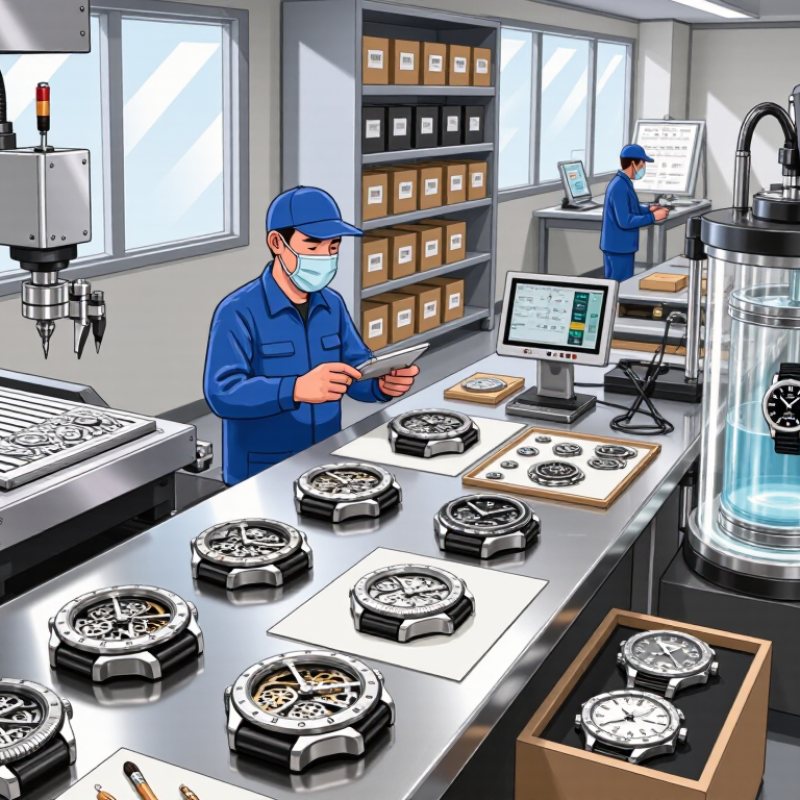
Understanding China’s Mechanical Watch Manufacturing Landscape
China Best Mechanical Watch Manufacturers for Global Buyers?
Understanding China’s Mechanical Watch Manufacturing Landscape
China’s mechanical watch industry spans component workshops, movement specialists, assembly factories, and export-focused manufacturers. This structure gives global buyers flexible sourcing options. Some factories produce cases, dials, hands, and straps in-house. Others coordinate several qualified suppliers. That difference affects lead time, quality control, and communication. A serious buyer should request movement specifications, material details, production photos, and inspection records before placing a large order. Experience matters here. A beautiful sample does not guarantee stable mass production.
Tips: Request at least two samples from separate production batches. Check winding smoothness, power reserve, hand alignment, case finishing, and water-resistance test results. Ask how rejected parts are handled. Small details reveal factory discipline.
Factory visits or independent audits can clarify working conditions, equipment, inspection routines, and production capacity. Buyers should also confirm export documents, packaging standards, warranty procedures, and spare-part availability. Clear technical drawings reduce misunderstandings. So does a written approval process. Mechanical watches remain sensitive products. Dust, uneven lubrication, or slight timing changes may appear after delivery. No factory is perfect. Even experienced teams can miss a defect. That is why staged inspections are more reliable than trust alone. Comparing factories by transparency, engineering support, and repeatability may be wiser than choosing only by price.

Key Criteria for Evaluating Chinese Mechanical Watch Manufacturers
Evaluating Chinese mechanical watch manufacturers requires more than comparing quotations. Deloitte’s 2024 Swiss Watch Industry Study surveyed 75 industry executives and highlighted supply-chain resilience, quality, and product value as continuing priorities. These points are useful for global buyers. Request movement specifications, case material reports, water-resistance test results, and production records. A reliable factory should explain tolerances clearly, not hide behind attractive photographs.
Factory experience matters on the production floor.
Ask to inspect assembly areas, lubrication tools, timing machines, and dust-control procedures. The Federation of the Swiss Watch Industry’s 2024 export statistics show that mechanical watches continue to represent a major share of Swiss export value, reflecting the premium placed on precision and finishing. Chinese suppliers should therefore provide measurable data, including daily rate deviation, power reserve results, return rates, and inspection sampling methods. Numbers are stronger than claims.
Check whether the manufacturer maintains ISO 9001-based quality procedures, traceable component records, and documented corrective actions. Confirm its capacity during peak seasons, minimum order quantities, prototype fees, packaging standards, and export documentation. The World Bank’s 2023 Logistics Performance Index also shows why delivery reliability must be assessed beyond factory promises. Ask for recent shipment evidence and realistic lead times. Not every impressive workshop is a stable supplier. Some factories outsource critical parts without explaining it. That is a weakness worth questioning. A small pilot order can expose inconsistent polishing, loose crowns, or inaccurate timing before a larger commitment.
Leading Chinese Mechanical Watch Manufacturers for Global Buyers
China’s leading mechanical watch manufacturers combine traditional assembly skills with modern production equipment. Many facilities use CNC machining for cases, screw-down crowns, and movement components. Experienced buyers should inspect sample watches before discussing large orders. A polished case can hide uneven tolerances inside.
Ask manufacturers to explain their movement sources, adjustment process, and quality records. A reliable factory should provide clear specifications for jewels, power reserve, accuracy, and water resistance. Timegrapher readings can reveal beat errors and unstable amplitude. However, one good reading proves little. Test several watches from different production batches.
Visit the workshop when possible. Observe dust control, lubrication practices, and final inspection stations. Request material certificates for stainless steel, sapphire crystal, and leather or textile straps. Packaging details also matter, especially for international transportation. Confirm carton strength, moisture protection, and replacement-part availability. Keep communication written and precise.
Small improvements matter. A crown that feels slightly rough may become a service problem later. Some manufacturers may promise shorter lead times than their capacity allows. This deserves careful questioning. Buyers should compare prototypes, production schedules, warranty terms, and after-sales procedures. A dependable supplier is not always the cheapest option. Sometimes, the less impressive factory has better records and more honest limitations.
Comparing Quality, Movements, Customization, and Production Capacity
China Best Mechanical Watch Manufacturers for Global Buyers?
Choosing a mechanical watch manufacturer requires more than checking polished product photos. Experienced buyers should inspect case finishing, dial printing, hand alignment, and water-resistance testing. A reliable factory can provide inspection records, movement test results, and sample videos from real production lines. Some suppliers communicate well but struggle with consistency. That gap matters.
Movement selection affects accuracy, serviceability, and product positioning. Automatic movements suit daily watches, while hand-wound movements create a thinner, more traditional feel. Ask about daily rate testing, power reserve checks, and available spare parts. Customization may include case dimensions, rotor engraving, dial textures, hands, packaging, and limited color runs. However, every added detail can increase tooling time and defect risk. Simple designs are not always easier.
Production capacity should be measured through evidence, not promised monthly numbers. Review assembly-line photos, lead-time records, quality-control stages, and a pilot order before scaling. A factory producing thousands of units may not handle small custom batches carefully. Another may offer excellent finishing but lack stable component sourcing. Both possibilities deserve scrutiny.
Tips: Request a functional sample, not only a display prototype. Compare three inspection reports. Confirm tolerances in writing. Visit the workshop when practical, or arrange a live video audit. Leave room for revisions; the first specification is rarely perfect.
China Best Mechanical Watch Manufacturers for Global Buyers
This chart compares three widely used mechanical movement frequency benchmarks. A higher vibration frequency can support smoother seconds-hand motion and potentially improved positional performance, but overall quality also depends on regulation, component tolerances, assembly, testing, customization capability, and production capacity. The figures are technical reference values rather than company or brand data.
How Global Buyers Can Select the Right Manufacturing Partner
Selecting the right mechanical watch manufacturing partner requires more than checking a polished factory website. Global buyers should examine movement testing, case finishing, assembly controls, and after-sales support. The Swiss Watch Industry Federation reported watch exports worth about CHF 26.7 billion in 2023. This scale shows the market’s competitiveness and high quality expectations.
Ask for measurable evidence. A reliable manufacturer should provide production capacity, inspection records, material certificates, and clear lead times. Request sample movements from different production batches. Check amplitude, power reserve, water resistance, and timing results after assembly. Small details matter. Deloitte’s 2024 Swiss Watch Industry Study identifies sustainability and supply-chain resilience as continuing priorities for industry executives. Therefore, buyers should also review energy use, traceability, worker training, and supplier continuity.
Tips: Visit the facility when possible. Watch a technician regulate a movement. Ask how rejected components are recorded. Compare promised output with actual monthly capacity. A factory may offer a low unit price, yet weak quality control can create expensive returns. Do not rely only on certifications; documents can become outdated. I have found that direct questions often reveal more than impressive presentations. Still, one visit is not enough. Production discipline can change when order volumes increase. Use a pilot order, define acceptance standards, and review performance before signing a larger agreement.
China Best Mechanical Watch Manufacturers for Global Buyers? - How Global Buyers Can Select the Right Manufacturing Partner
| Evaluation Dimension | Recommended Benchmark | Why It Matters | How Global Buyers Can Verify | Priority |
|---|---|---|---|---|
| Mechanical Movement Capability | Demonstrated experience with automatic or hand-wound movements, including assembly, regulation, lubrication, and testing. | Movement quality has a direct effect on accuracy, power reserve, serviceability, and customer satisfaction. | Request movement specifications, assembly records, sample test results, and a detailed production process map. | Critical |
| Accuracy and Regulation | A documented accuracy target should be agreed by position, temperature, and power-reserve condition; acceptance limits must be written into the purchase specification. | Mechanical watch accuracy varies with position, winding state, temperature, and movement adjustment. | Ask for time-grapher readings in multiple positions and define the measurement method, duration, and allowable deviation before mass production. | Critical |
| Power Reserve Performance | The tested power reserve should meet or exceed the movement specification under a consistent winding and measurement procedure. | Insufficient or inconsistent power reserve can indicate assembly, lubrication, mainspring, or regulation problems. | Review batch test reports and compare fully wound samples after controlled testing conditions. | Critical |
| Water-Resistance Testing | The stated water-resistance rating must be supported by a defined test method and quality-control record; water-resistance claims should not exceed validated test performance. | Case sealing depends on gaskets, crown construction, crystal fitting, case tolerances, and assembly quality. | Request dry or wet pressure-test records, gasket specifications, and the written acceptance criteria for each production batch. | Critical |
| Quality Management System | A documented quality system with incoming inspection, in-process controls, final inspection, traceability, and corrective-action procedures. | Formal controls reduce recurring defects and make supplier performance measurable. | Review audit reports, inspection forms, nonconformance records, calibration certificates, and corrective-action examples. | Critical |
| Material and Component Traceability | Critical components should be traceable by purchase order, batch, supplier, inspection result, and production date. | Traceability supports root-cause analysis, warranty management, and consistent repeat orders. | Request sample traceability documents for cases, crystals, crowns, gaskets, hands, dials, and movements. | High |
| Prototype and Sampling Process | The supplier should provide a controlled sample process with documented revisions, approval stages, and pre-production confirmation. | Sampling identifies fit, finish, assembly, dial alignment, hand clearance, and packaging problems before production. | Require a signed sample approval sheet, revision history, component drawings, and a pre-production checklist. | High |
| Case and Dial Finishing | Finishing specifications should define surface texture, polishing, brushing direction, coating thickness where applicable, color tolerance, and defect limits. | Visible finish consistency strongly influences perceived product quality. | Inspect samples under controlled lighting and use approved golden samples, limit samples, or measurable visual standards. | High |
| Production Capacity and Scalability | Capacity should be demonstrated with current equipment, staffing, lead-time data, and a realistic plan for peak demand. | A supplier may produce excellent samples but struggle with repeatability or delivery at larger volumes. | Compare stated capacity with production schedules, equipment lists, staffing levels, and anonymized delivery records. | High |
| Minimum Order Quantity and Cost Structure | The quotation should separate development fees, tooling, component costs, assembly, testing, packaging, shipping terms, and payment milestones. | Transparent pricing makes supplier comparisons more accurate and reduces unexpected charges. | Request an itemized quotation and confirm which costs are refundable, recurring, variable, or dependent on order volume. | High |
| Lead Time and Delivery Reliability | A written timeline should cover engineering, sampling, component procurement, production, inspection, and shipment, with agreed delay procedures. | Mechanical watches often require coordinated procurement and several inspection stages. | Review historical on-time delivery performance and include milestone dates and remedies in the contract. | High |
| Compliance and Product Documentation | Documentation should cover materials, country-of-origin requirements, packaging, labeling, customs information, and destination-market obligations. | Import and retail requirements vary by destination and product configuration. | Confirm documentation responsibilities with an independent compliance specialist or customs adviser before shipment. | High |
| Intellectual Property Protection | Use a written confidentiality agreement, clear ownership clauses, controlled access to drawings, and approval requirements for subcontracting. | Design files, dial artwork, case geometry, and product specifications are commercially sensitive. | Confirm contract enforceability with qualified legal counsel and limit technical information to the minimum needed at each stage. | High |
| After-Sales and Warranty Support | The supplier should define warranty duration, defect classification, replacement or repair procedures, spare-part availability, and response times. | Mechanical products may require adjustment, repair, or replacement of specific components after delivery. | Request a written warranty policy, service workflow, spare-parts list, and anonymized examples of resolved claims. | High |
| Communication and Engineering Support | A dedicated contact should provide clear technical answers, updated schedules, inspection evidence, and prompt escalation of production risks. | Fast, accurate communication reduces specification errors and prevents avoidable delays. | Evaluate response quality during sampling, use written change-control procedures, and record decisions in shared documentation. | Medium |